Losing a spouse is one of life’s most painful experiences, and in the midst of grief, surviving partners are often faced with overwhelming financial decisions. From settling estates to adjusting to changes in income, the process can feel like an impossible burden to carry alone. Without a plan in place, surviving spouses may find themselves vulnerable to financial missteps at a time when clarity is hardest to find.
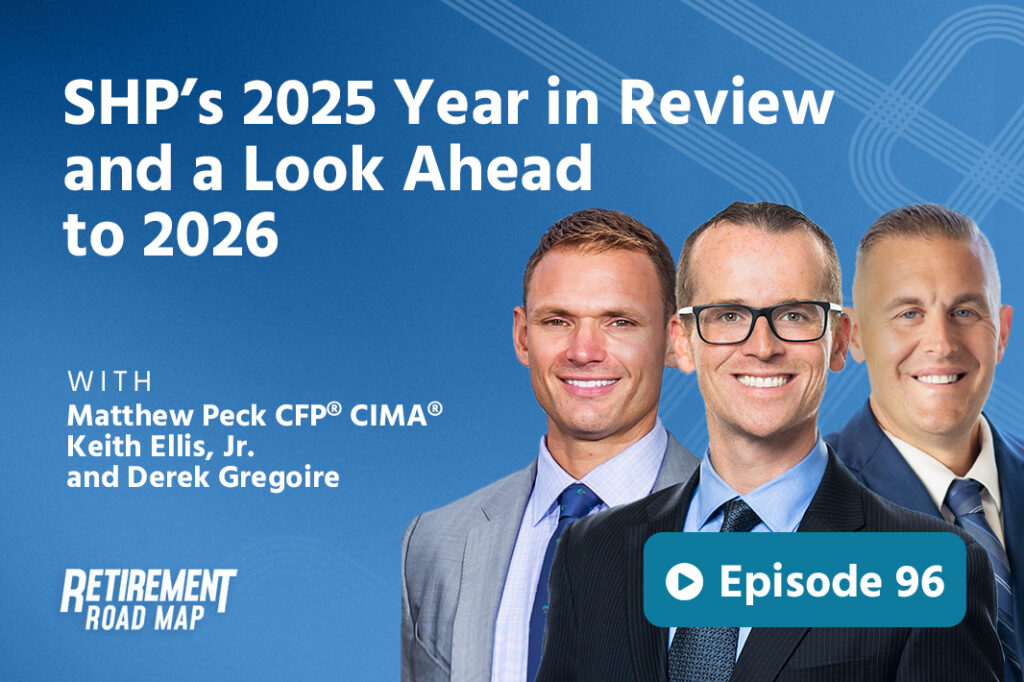
In this episode, SHP Financial’s Derek Gregoire is joined by Planning Advisor Alina Osokhovska, CFP® to explore the critical importance of financial planning for widows. With years of experience guiding families through difficult transitions, Alina explains how proper planning can bring stability, reduce stress, and provide widows with the confidence to focus on healing rather than paperwork.
In this conversation, Derek and Alina unpack the key financial considerations after the loss of a spouse, from estate settlement and tax bracket changes to Social Security benefits and cash flow adjustments. They also discuss proactive strategies for couples to ensure that if the unthinkable happens, surviving spouses are not left unprotected.
Whether you are preparing for the future or currently walking through loss, this episode offers compassionate guidance and practical steps to ease the burden during one of life’s most difficult transitions.
In this podcast interview, you’ll learn:
- Why women are statistically more likely to become widows and the financial challenges that come with it.
- The critical first steps when settling an estate after the loss of a spouse.
- How income and cash flow change when pensions, Social Security, or other benefits are reduced or lost.
- The hidden tax consequences widows often face and how proactive planning can help mitigate them.
- Advanced planning strategies for couples, including estate exemptions, step-up in basis, and inherited IRA considerations.
Inspiring Quotes
- “Losing a spouse is one of life’s most difficult experiences, and beyond this pain, there’s a wave of financial decisions, complex financial decisions that need to be made, and sometimes quickly.” – Alina Osokhovska
- “If they have a taxable account with highly appreciated assets, those can be shifted to the ill spouse. So, upon that spouse’s death, the assets will get a step up on cost basis and thus eliminating that huge tax burden for the surviving spouse.” – Alina Osokhovska
Interview Resources
[INTERVIEW]
Derek Gregoire: Alright. Welcome, everyone, and we are very excited to have Alina with us today. And she’s really doing a great job as a CFP, a certified financial planner, on our financial planning team at SHP Financial. And we have a really, really important topic, one that’s relevant to so many, unfortunately, over the years that we deal with, but it’s around financial planning for widows. So, I know it’s a very depressing topic, but something we have to make sure we address. And, yeah, thanks for joining me, Alina. I appreciate it.
Alina Osokhovska: Hi, Derek. Hi, everyone. So glad to be back. This topic is so important, and it affects more people than we really realize.
Derek Gregoire: Yeah. Just talking off air, we had a good friend in their fifties lose a spouse recently. And just dealing with all the things we’re talking about, Alina had drafted a lot of these notes before this happened, unfortunately, but it’s also relevant because I’m in the middle of this situation right now. And unfortunately running this company for over 22 years, or almost 22 years, I’m sorry, we’ve seen so many scenarios like this, and people that have a plan, it works out. Unfortunately, sometimes when they don’t plan, it can be really hard. No matter what, it’s going to be hard. It’s a path that no one wants to go down.
But we always say, if we can do our job and make things a little bit easier financially, one less thing to worry about, so the spouse can grieve and do what they need to do, that’s a big important part of what we do here at SHP. So, start with a big picture. Why is financial planning for widows so important?
Alina Osokhovska: It’s a great question. Losing a spouse is one of life’s most difficult experiences, and beyond this pain, there’s a wave of financial decisions, complex financial decisions that need to be made, and sometimes quickly. And a lot of people don’t realize that 80% of men will die married, while 80% of women will die single. 70% of wives will become widows, and of those who remarry, over 70% will become widows again. So, that’s eye-opening, and that’s why it’s so essential, especially for women, to be financially prepared.
Derek Gregoire: Yeah. So, let’s say, obviously, those are eye-opening stats. When you think about it, it’s crazy. And that’s always a joke like, “Oh, the men, we don’t have the same life expectancy and so forth.” But before we get into this, I want to also add too, we might touch on this more down the road, but over the years, a lot of couples have joined our firm over the years because one of the other might be the one that does all the financial planning, right? And with that scenario, if, let’s say, one spouse does all the planning, and the other spouse kind of like, “Yeah, I just rely on him or her,” right? Well, in that scenario, if you don’t have a plan, let’s say, Alina, you’re the person doing everything, and something happens and you pass away, your spouse at that point, they don’t know what to do, so they can be vulnerable.
In our field, not that there’s a lot of bad apples, but there are some bad apples that just, “Hey, here’s a quick plan.” Next thing you know, they don’t know what to do, and they’re kind of like, “Oh, I guess I’ll sign up with this person. It could be a bad decision.” What I find is a lot of people that do it right, that are good planners, that want to get ahead of it, they want to do things even if they feel like confident that they can do some planning on their own and some portfolio management on their own, a lot of times, they’ll work with us ahead of time to make sure that if anything happens, their spouse, they know there’s a plan in place, they trust the firm they’re working with, and so forth. You know what I mean?
Alina Osokhovska: That’s a great example, Derek, because you’re so right. After losing a spouse, a lot of widows, they experience this like a foggy state, where it’s difficult to make decisions, and sometimes you have to make those decisions, right? And some people, unfortunately, take advantage of that, and they try to sell them products that they don’t need. And it can dramatically affect their financial plan and their cash flow, or other important aspects of the financial plan. So, it’s very important to work with someone you can trust and who will really take care of you.
Derek Gregoire: So, I know, hopefully, this isn’t affecting a lot of folks that are listening or watching this podcast, but I know there’s plenty out there. I know, even if it doesn’t, there are things you’re thinking about, like, “God, if something happens, what do I do?” So, what’s the first thing someone should do financially after losing a spouse?
Alina Osokhovska: Well, the first step will be selling the estate, right? It’s not fun, but it has to be done. And if a couple had an estate plan done before, that would be so much easier, and that process can go relatively smoothly, but if the documents were outdated or even missing, this process can become complex and emotionally taxing very quickly.
Derek Gregoire: Oh yeah, I’m sure, because if your ducks aren’t lined up, when you say estate planning, it’s like wills, trusts, clear beneficiary definitions, all that has to be in place. What about estate taxes? Can that become a decent issue in terms of Massachusetts and federal?
Alina Osokhovska: Absolutely. So, right now, we have people deal with sort of taxes, federal estate tax exemption, and Massachusetts, that’s state taxes. In our case, it’s Massachusetts. So, federal estate tax exemption is at all-time high. It’s going to be $15 million next year.
Derek Gregoire: That’s per person, right?
Alina Osokhovska: That’s per person. So, $30 million for married couples filing jointly. And it’s portable, so it means that if one spouse hasn’t fully utilized that exemption, it just passes to the surviving spouse.
Derek Gregoire: So, it’s really $30 million before you have to worry about it.
Alina Osokhovska: Exactly. So, I think most households in the United States don’t have to worry about federal estate tax, which is good. On the other hand, a state tax is more of a concern right now.
Derek Gregoire: Yes.
Alina Osokhovska: For example, in Massachusetts, the legislation passed in 2023 raised the exemption from $1 million to $2 million.
Derek Gregoire: It’s about time. It was like that for 20-something years.
Alina Osokhovska: I know. But it’s not even indexed for inflation, which is going to stay 2 million for the next legislation, I guess. And it’s also not portable, so if one spouse hasn’t fully utilized it, it wasn’t secured by, for example, like a trust document, trust planning, it’s just going to be lost.
Derek Gregoire: So, that’s a good point. So, when she says it’s not portable, it means, let’s say there’s a couple that married and they didn’t do proper planning. Well, they’re each allowed $2 million of exemption before their estate is taxed. If you do a proper planning, then you can actually have $4 million worth of protection preserved. But if, let’s say, you didn’t do the proper planning and one spouse passed away, that’s gone. So, the well spouse that’s still living only has $2 million instead of four. So, you lose it. If you don’t do the planning, you lose it. So, that’s why it’s important you don’t wait to do this when you’re a widow and force you do it. You try to do it ahead of time. So, that’s critical around state taxes. That can add up to some serious dollars. What if someone owns a property in another state, what does that look like?
Alina Osokhovska: So, for example, in Massachusetts, we have a lot of snowbirds, right?
Derek Gregoire: Yes.
Alina Osokhovska: Let’s use Florida, right? Florida residents for income tax purposes, because there is no income tax, so it’s more beneficial for them, but they do have a house in Massachusetts. So, technically, they are still subject to Massachusetts state tax. Massachusetts, what it does, it takes into account the total gross estate first to determine whether there is a taxable estate, and the threshold is $2 million, right? And then proportionally, it taxes only the property in Massachusetts. So, still, if the property is expensive, it can push over the limit, and there can be a potential tax liability.
Derek Gregoire: Even if they own it in Florida?
Alina Osokhovska: No. If the house is in Mass.
Derek Gregoire: I’m sorry. I thought, okay.
Alina Osokhovska: But if they’re still Florida residents, they still can have a Massachusetts.
Derek Gregoire: Gotcha. What if they’re Massachusetts residents with a house in Florida?
Alina Osokhovska: So, potentially, their tax liability would be greater just because all their property that they own, except for the Florida residents, will be taxed.
Derek Gregoire: Gotcha, okay. Just double-checking. In terms of the estate settlement process, what are the important steps in that? Like, when settling the estate, it really means someone passes away. What do you do? In essence, what it means?
Alina Osokhovska: You need to have a clear picture of all your assets together and start working from that list. Retirement accounts, you need to make a decision whether to treat those as your own or treat as inherited IRA accounts. And there are some very important considerations in regard to required minimum distributions when you can access the funds without a penalty. So, if a spouse, the surviving spouse, is younger than 59 and a half, you access that account earlier, before 59 and a half, without a penalty if they treat that account as an inherited IRA. But if they treat that account as their own, there will be a penalty.
Derek Gregoire: Well, only if they take withdrawals.
Alina Osokhovska: Exactly.
Derek Gregoire: So, they follow the regular IRA rules.
Alina Osokhovska: Exactly.
Derek Gregoire: Yep. If you’re inheriting money from a non-spouse, it has to be an inherited IRA.
Alina Osokhovska: Yes, exactly.
Derek Gregoire: So, you have, like, all the retitling of accounts. You have to update beneficiaries on your accounts. You try to consolidate. So, again, working with a recent couple or one of the spouse had passed away, brutal. Great people, people I’ve known for a little while, but this is like, they have, like, three or four bank accounts. They just, “Hey, let’s get it to one.” Let’s take a spouse’s name off it. Get it to one account. Let’s make sure there was a 401(k), let’s get an IRA in the living spouse’s name, and just getting everything transferred and done according to all these rules. So, what about like cash flow? How does this change in terms of their cash flow and income when a spouse passes away?
Alina Osokhovska: Right. Usually, the expenses stay around the same, right? Because you still need to pay the property tax.
Derek Gregoire: Heat and electric stay the same, right?
Alina Osokhovska: Exactly, doesn’t really change. Doesn’t count for one spouse not being there anymore, but the income can change. For example, if one spouse received a pension and didn’t have Survivor Benefit, that’s going to be lost. Another source of income that wasn’t properly structured or didn’t count for the surviving spouse that’s going to be lost. So, that shortfall has to be addressed and taxed efficiently, too.
Derek Gregoire: So, you also have Social Security, that if you’re on Social Security, or even if you’re not, is you have the potential of getting two Social Security checks. Now, you’re only getting one. Now, you get the higher of the two, but the other one just goes away. So, the expenses might be similar, but you’re losing this income.
Alina Osokhovska: Exactly. And also, I’m glad you brought up the Social Security, because there is planning around the Social Security benefits and when it should be claimed to the survivor benefits, and also the spouse’s benefits, right? So, for example, you can claim the survivor’s benefit as early as 60, at 60,
Derek Gregoire: So, normally, Social Security, earliest age is 62, but if someone passes away, the spouse can claim as early as 60.
Alina Osokhovska: Exactly.
Derek Gregoire: But it’s reduced a little bit.
Alina Osokhovska: Yeah, it’s going to be around like 75% of the full retirement benefits. It’s not bad.
Derek Gregoire: This is not bad.
Alina Osokhovska: But if you do need to supplement your cash needs to pay for your expenses, sometimes it’s just necessary to turn on that income. For disabled spouses, you can do it as early as 50 years old. So, that’s like another beneficial consideration. But also, I think the strategy can be to decide about your cash needs, whether you need cash right now, and also taking a look at your own benefits. Because if your own benefits are higher than your survival benefits, perhaps you can turn on the survival benefits now to pay for some expenses and then delay taking your benefits or claiming your benefits until later years, or even until 70 just to…
Derek Gregoire: So, that’s a lot.
Alina Osokhovska: Yeah.
Derek Gregoire: I know. Everyone talks about, like, “Well, when do you hire a financial advisor?” You can see there’s so much more planning. By the way, you can do it when both are well and alive, and so you don’t want to wait until someone passes away. But what’s the biggest role we play at this point for the spouses, all the things we’ve talked about? Is it just kind of…
Alina Osokhovska: At this point like when the…
Derek Gregoire: Yeah, someone passes away. Like, what are the main things you’re seeing as like a planning point?
Alina Osokhovska: We help our clients, right? We try to make this financial part of that process easier for them. So, we handle all the beneficiary changes. We handle, like we open an estate account, so we do all that administrative stuff for them, so they can actually concentrate on more grieving and, like, funeral arrangements and all that necessary things that have to be done. So, we do that. We also review their cash flow, and see like, “Okay, so what are your cash needs right now?” Because sometimes they will have some one-off expenses, like funeral costs, legal costs, with the estate process. But some expenses will not go away. So, we have to take a look at their plan and see, okay, so if they need some additional cash, what account should we use?
We have to be mindful of their tax liability, because they can claim married filing jointly status only in the year when the spouse dies. Next year, they switch to a single status, which can bring some more tax liability, because the deduction is smaller, the brackets are narrower, the income can be kind of the same, so now they have to pay more taxes.
Derek Gregoire: Well, that’s huge. Let’s say, so Alina made a great point that when you talk about taxes and tax filing brackets so, for example, if you have, let’s say, your income is $125,000. Well, you might be around the 12% bracket, in that range, maybe a little bit higher, but around that range if you’re married filing jointly. Let’s say one of the spouses passes away. Well, the RMDs are still going to be the same. The IRA values are the same. You might lose some income, but at $125,000, now, you might be in the 22% tax bracket.
Alina Osokhovska: Exactly.
Derek Gregoire: So, think about that. That’s a 10% tax increase. Well, it’s more than 10% on the… 12 to 22 is more than 10% but there’s an overall huge jump in tax brackets. So, remember, your expenses are the same, but now you’re keeping less of what you have coming in. So, tax bracket management is another important subject. I mean, I hope no one’s listening, like, getting a little nervous, but this is why you do planning, right? What else should widows consider from a planning standpoint? Let’s say the foundation’s done. They have stuff to settle. There’s no other way to put it, but they’re starting to, like, see a little bit of sunlight. They’re always going to grieve indefinitely, but they’re starting to, you know, okay, we have our basic needs covered.
We have cash flow. The advisory team at SHP or whoever you’re working with has devised a plan to make sure you’re going to be okay. What accounts to draw from the most tax efficiently? Once that’s said and done, what’s the next part of planning that they would consider?
Alina Osokhovska: Well, their plan will change as well, right? So, they’re embracing a new life, so they probably plan for a joint life together. So, now they’re living alone, and their goals might change, or they can remarry, and people do that, and sometimes just helps with grieving, and just like a next chapter of your life. So, when those change, we also need to update their plan. But also, I guess, a very important part is to take care of their estate plan. So, once the estate has been settled.
Derek Gregoire: Yeah, settled.
Alina Osokhovska: Thank you. I need some coffee. The estate has been settled, we need to update their estate plan to account for now they’ve lost their spouse. So, what’s going to happen next? Who they want to inherit their wealth, and how to do it more tax efficiently? So, that is a very important step.
Derek Gregoire: It’s like I said, Keith and Matt and I running the company for over 20 years. Funny, we know, like there’s a lot of value being provided, one spouse passing away, how much work goes into the plan from that point forward over the next several months. And we’ve seen it. We’re going to do whatever we can to be there for that spouse. That’s our main priority. But the planning side, it’s a lot of work, because there’s tax. You’re trying to hold certain tax exemptions. You’re trying to make sure the spouse is okay, trying to make sure the short-term is covered. You’re trying to make sure their income’s covered, but they might not have known how much income they need. They might not know their expenses. You have to start calculating that.
What about like the healthcare changes, how to cancel one but keep the other? I mean, the list goes on and on and on, but I think we all know that good, solid financial planning. That’s why, when we build plans here, we say the SHP Retirement Roadmap that looks at income, investments, taxes, health care, and estate planning, and Alina and her team do a great job. I mean, like I always joke around, I will get 13 pages of notes for one client meeting. But it’s great. That’s what makes us different, like with the true planning we’re providing. So, any other thoughts and prayers and everything you do for someone going through this, but any other recommendations that you have for like someone that’s just lost a spouse?
Alina Osokhovska: I do. I can recommend a National Widows Association, and our listeners who are interested, they can visit their website, thenwaonline.com. So, they offer emotional, financial, spiritual support for widows.
Derek Gregoire: That’s a great resource, and obviously, like I said, before we wrap up and close out, it’s a lot of information. I think everyone’s head might be spinning. Are there any other advanced strategies to use where, let’s say, someone has a spouse, and this is another situation I’m dealing with right now as well, like another client with a spouse who has terminal cancer? And so, what other strategies might be able to do in that scenario where their spouse is terminally ill?
Alina Osokhovska: That’s a great question, and there is some planning that can be done to help the surviving spouse. And what can be done, for example, if they have a taxable account with highly appreciated assets, those can be shifted to the ill spouse. So, upon that spouse’s death, the assets will get a step up on cost basis and thus eliminating that huge tax burden for the surviving spouse. So, that’s planning that can be very beneficial. Also, if someone has carry-forward loss, if it’s not utilized during their lifetime, it’s just going to be lost.
So, also, it’s important, like, if an ill spouse has a carry-forward loss, let’s utilize it. Let’s sell some appreciated assets to get that exactly to have said that and maybe move those assets to the healthy spouse and keep the other appreciated assets in that ill spouse’s account to get the step-up and cost basis.
Derek Gregoire: Really good ideas. I’ve explained this thousands of times over the years, but if you look at the five areas of our Retirement Roadmap, income, investments, taxes, healthcare, and estate planning, right? But when you break down each one, it sounds like, “Oh, there’s only five things.” No. When we go to tax planning, there’s step-up basis, there’s carry-forward losses, there’s Roth conversions, there’s HSAs, there are certain trust planning to mitigate taxes. We could probably sit here and go back and forth and add 10 more different. There’s donor-advised funds, there’s QCDs, there’s like so many strategies that can be used, but obviously, what applies to that person. Then you go to, like, income, pension analysis, Social Security analysis. If someone passes away, you have different options as well. Expense analysis.
So, you can see, even though there’s five worlds of financial planning, each world has like 10 different branches, if not more. So, that’s why I always say, like, even if you’re a do-it-yourselfer, and you’re listening, I urge you, if you’re married, especially even if you’re do-it-yourselfer, you might be good at portfolio management but imagine keeping up with all the things SECURE Act, One Big Beautiful bill, SECURE Act 2.0. I mean, these things change all the time. Like I mentioned, Keith, Matt, and I have run the company 22 years. I don’t know everything. That’s why we have people like yourself who follow the changes in the tax law. We have CFAs and analysts who do the portfolio research, right? That’s why there are teams in place.
So, even if you’re a do-it-yourselfer, hopefully, you can be able to get all this knowledge to apply. But even if you can, I want you to think, can your spouse, can your wife or husband, if you pass away, do it at the same level? If not, you definitely want to find a firm, whether it’s SHP or some other firm that can do this, because you want to make sure, and maybe this is the way I think, if something happens to me, I want to make sure my wife isn’t thrown to the wolves, or like in some really, really bad situation where she’s vulnerable, right, and might make a decision that might not make sense. I want a firm that I know that would carry out all my wishes for my spouse. So, if you’re not sure, like I said, we have a lot of resources on our website, shpfinancial.com.
You can always call 866-746-2401, but like I said, we’re happy to help. We’re happy to be a resource. If you want to take some time to come in, that’s great too, but just a lot of resources online at shpfinancial.com. As always, I know this is not the brightest topic, Alina, but thank you for bringing a smile either way, bringing some good information. And for all of our listeners, thank you so much for joining us. We’ll be back with the next podcast very soon. And hope you have a great day.
Alina Osokhovska: Thank you.
[END]
Certain guides and content for publication were either co-authored or fully provided by third party marketing firms. SHP Financial utilizes third party marketing and public relation firms to assist in securing media appearances, for securing interviews, to provide suggested content for radio, for article placements, and other supporting services.
The content presented is for informational purposes only and is not intended to offer financial, tax, or legal advice, and should not be considered a solicitation for the purchase or sale of any security. Some of the informational content presented was prepared and provided by tMedia, LLC, while other content presented may be from outside sources that are believed to provide accurate information. Regardless of source, no representations or warranties as to the completeness or accuracy of any information presented are implied. tMedia, LLC is not affiliated with the Advisor, Advisor’s RIA, Broker-Dealer, or any state or SEC-registered investment advisory firm. Before making any decisions, you should consult a tax or legal professional to discuss your personal situation. Investment Advisory Services are offered through SHP Wealth Management LLC., an SEC-registered investment advisor. Insurance sales are offered through SHP Financial, LLC. These are separate entities. Some supervised persons of SHP Wealth Management, LLC, are independent licensed insurance agents of SHP Financial, LLC. No statements made shall constitute tax, legal, or accounting advice. You should consult your own legal or tax professional before investing. Both SHP Wealth Management, LLC. and SHP Financial, LLC. will offer clients advice and/or products from each entity. No client is under any obligation to purchase any insurance product.