With over 20 years of financial planning experience and having helped thousands of retirees and pre-retirees successfully plan for retirement, we’ve learned which planning mistakes can derail retirement and which strategies help clients retire with confidence and peace of mind.
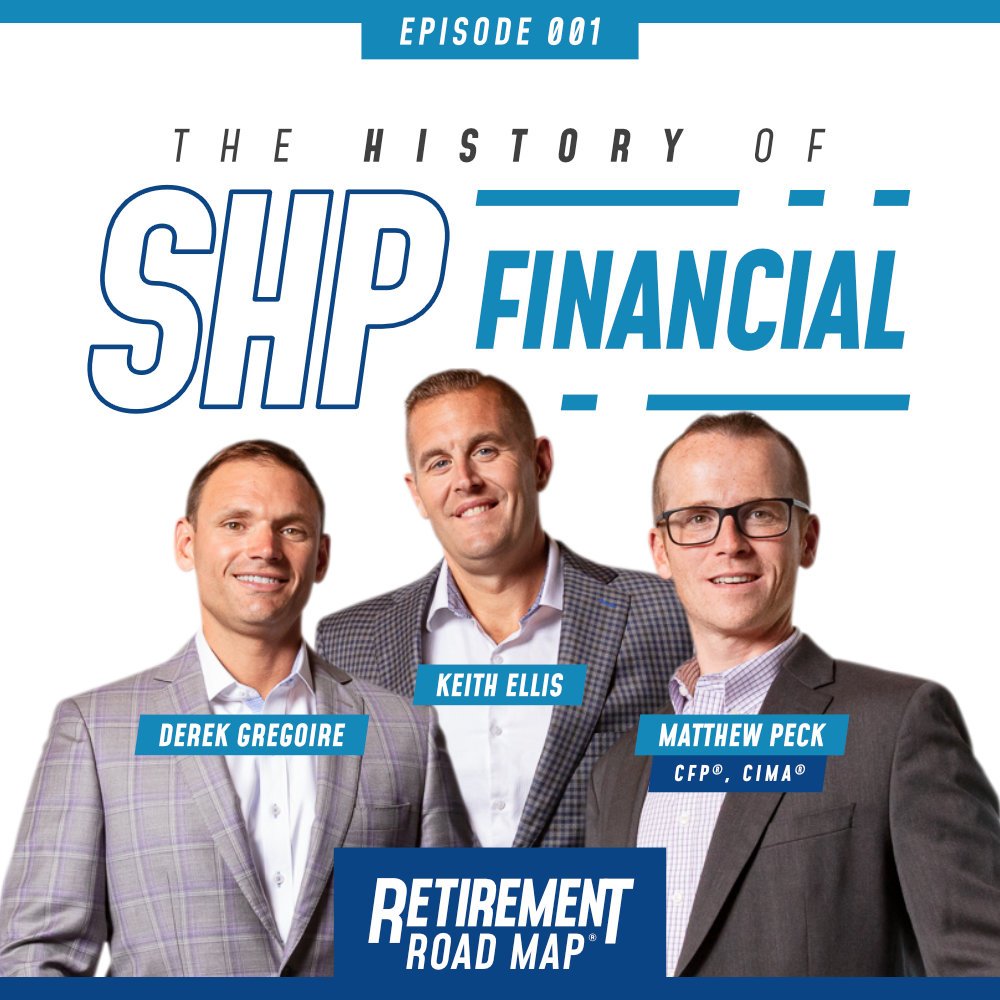
In this very special episode, SHP Financial’s co-founders Derek Gregoire, Keith Ellis Jr., and Matthew Peck reflect on the biggest lessons they’ve learned after 100 podcasts and all the years of building a successful wealth management firm. From evolving investment strategies to the growing importance of tax planning and behavioral finance, they share insights from both their professional experience in the industry and in conversations with past guests.
They discuss how retirement planning has shifted from focusing solely on income to a comprehensive approach that includes tax efficiency, risk management, healthcare, estate planning, and charitable giving. They also offer practical advice on avoiding mistakes, handling market volatility, and building a retirement plan that ensures financial security and peace of mind.
In this podcast interview, you’ll learn:
- How retirement planning has evolved beyond just income strategies.
- Why understanding and managing investment volatility is critical in retirement.
- The importance of tax diversification across pre-tax, Roth, and after-tax accounts.
- Lessons retirees often learn too late about required minimum distributions and taxes.
- How behavioral biases like overconfidence can impact long-term investment success.
- Why comprehensive planning is more powerful than managing investments alone.
Inspiring Quotes
- “When you start to look at it from the mental aspect of it and just making sure our clients are prepared for the rollercoaster after they’ve retired, that is something that becomes a bigger part of the planning process than it used to.” – Matthew Peck
- “If you panic in a downturn and the loss is too much, and you sell, it’s over. You’re just not going to recover.” – Derek Gregoire
- “When the market’s down, that’s when you can do a ton of planning.” – Derek Gregoire
- “Trusts aren’t like magical pills that cure taxes and healthcare issues.” – Keith Ellis Jr.
- “If you can take care of the small things in business or in life, the bigger things will take care of themselves.” – Derek Gregoire
Interview Resources
- Saint Andrew’s Cross
- ILIT
- Medicare
- IRMAA
- Donor-Advised Fund
- QCD
- IRA
- NVIDIA
- Michael Jordan
- The Patriots
- Seahawks
[INTERVIEW]
Laura Russo: Hello, hello, everyone, and welcome to a very special episode of our SHP podcast. We are celebrating our 100th episode, and we are here live in the SHP office recording, and we have our fearless leaders here: Keith Ellis, Derek Gregoire, and Matthew C. Peck. Hey, guys. How are you doing today?
Derek Gregoire: How are you? I love the C.
Laura Russo: Yeah, it’s always Matthew C. Peck
Matthew Peck: Oh, absolutely.
Laura Russo: Yeah. There’s no other way.
Matthew Peck: Oh, absolutely. It makes it much more official. Like, no one would respect me if I didn’t have a middle initial.
Laura Russo: Correct. Yes, correct.
Matthew Peck: So, you’re really going to drop that.
Laura Russo: Well, today, guys, we have a lot that we’re going to unpack, and I think just having 100 episodes under your belt, I just want to first start and ask you, guys, how does that feel?
Derek Gregoire: I’d say it’s something we’ve obviously been doing radio for years and started doing that back in, I don’t know, 2007 or so. As we got going with that, we just figured next step is podcast. We didn’t know what a podcast was back then, so it’s starting the first, second, third, it’s like, “Oh, here we go,” and then you hit a hundred, it’s pretty cool. And I don’t know if, obviously, people can’t see this on their end, but we do have a lot of our team in here, so that’s a little bit awkward as well.
Laura Russo: I think the word is special.
Derek Gregoire: Yeah, exactly.
Laura Russo: Well, guys, let me ask you, looking back from where we started, we’re going to just dive right in. So, I want to ask you some questions. If you’re looking back, what are some of the biggest philosophy changes that you’ve seen? What are some of the biggest shifts in mindset that you guys would see as far as retirement planning from when you did your first episode? Because, obviously, a lot of things have probably changed, and you guys have experienced different things. So, what are ways that you would say that are some mindset shifts that you’ve had?
Matthew Peck: I think the biggest thing personally is the importance of sort of the mental health and not mental health in the sense of psychology, but more about the preparing people mentally for retirement because when you have a market loss, and you’re retired, and you no longer have that working income, that can cause a lot of stress, that can cause a lot of pain, and people will no longer enjoy their retirements. If something like that happens at the same time that they’re retired, that they no longer have a job, or if there’s like a big renovation, so when you start to look at it from the mental aspect of it and just making sure the people are prepared for the rollercoaster after they have retired is something that I think really becomes a bigger part of the planning process than it used to.
Derek Gregoire: Yeah, I would say or interrupt there, when we started, it was all, I remember like back in the day, it was all income is king, income, income, income, and it still is. You can’t retire without income, but that was like 15 years ago. That’s where our planning started and stopped was around having enough income for the rest of your life. And then, so I think just what’s evolved is there’s like so much more to planning, and every year it becomes even more comprehensive in terms of what’s involved in a plan for a client. It used to be, okay, make sure they have enough, and they’re good to go. And now that’s like 1/100th of a plan. So, I think that’s kind of the biggest difference.
Keith Ellis Jr.: And I would say the emphasis around taxes, tax planning, that’s really come to the forefront, and specifically here, being able to better position both our clients, as well as their families long term to have what we believe to be a better tax horizon. So, yeah, I mean, tax planning I think has really come to the forefront here.
Matthew Peck: And just to add to that, because obviously it’s very current, I mean, here we are at the 100th episode, I think private markets are playing more and more of a role under the investment management side of things, where if we went back, even when we were doing radio, much less the first couple podcast, private equity, private credit, infrastructure, or things like that, that we knew what they were, but didn’t really availability and working it into portfolios was not something that we had done as much. And so, now, here we are at the 100th anniversary, or I’m sorry, 100th anniversary, 100th podcast, it’s a completely different story, where now we can really go anywhere with the portfolio side of things to drive those income, to do that tax planning, and to really round out the plan.
Laura Russo: Yeah. That’s really good.
Derek Gregoire: Maybe by like our 200th episode, we’ll be able to afford four microphones instead of Keith and I sharing this.
Matthew Peck: It’s very cute, though. I love it. It’s almost like…
Laura Russo: It’s cozy.
Derek Gregoire: Take turns.
Keith Ellis Jr.: We’re cozy.
Matthew Peck: Yeah, it’s great.
Laura Russo: Well, Matt, I think you made a really good point and a good segue for us to talk a little bit about investment lessons that you’ve learned over the years and over the 100th podcast, not a hundred years. So, one quick question I want to ask you guys is maybe what’s something that you would find that’s underrated that a lot of people kind of don’t consider when it comes to risk?
Matthew Peck: Do you guys like to take that one or no? Was that directed towards me?
Derek Gregoire: I think that was more the investment committee guy.
Matthew Peck: Ah, I see. I think it’s overall volatility. I think the experiencing volatility or managing volatility is so crucial because that’s the ride. I mean, think about the rollercoaster people talk about volatility are the rails themselves, where if you have a highly volatile or very risky portfolio, you’re going to have significant ups and downs and drops and things along those lines, where if you have what’s called an area to get nerdy, good thing I wore my glasses, so I was perfectly ready for this.
Derek Gregoire: And the sweater.
Matthew Peck: Oh, this sweater, St. Andrew’s Cross, baby. For anyone that’s been to Scotland, let me tell you all about Scotland. I’m not sure if this is the podcast to talk about it.
Laura Russo: No, it’s not.
Matthew Peck: But we could talk about St. Andrews. This guy wants to talk about St. Andrews if he could.
Derek Gregoire: I was more interested in standard deviation.
Matthew Peck: Which I think is a lie because he’ll talk golf anytime. But no, what the idea of measuring that, I mean, you could take all of these holdings, you could take clients’ holdings, and you can analyze them to break down, like how wild of a ride is it going to be. Now, you can go down to what’s called a risk number, which kind of simplifies it on a scale of 1 to 100. You can get to that next level of deviation, standard deviation, which is also kind of just another mathematical way of measuring it. But the whole goal is to find the ride that the client is comfortable with. And that’s appropriate for what they’re trying to accomplish, and what their income goals are, and growth goals are.
But you can really narrow that down. And so, that just helps with the expectation of going forward, where if a client’s looking or saying like, “Hey, oh yeah, I’m good with risk.” And you set them up in that portfolio, and then they call you upset when the market drops. Like, “Buddy, you asked for this.”
Derek Gregoire: Yeah.
Matthew Peck: Right? So, you can help manage your expectations going forward by really keeping an eye on all of those metrics.
Derek Gregoire: Zach Perkins and I had a meeting recently, and he’s a CFA, and I think it’s the highest one of the credentials you can have as an analyst and portfolio manager. And so, I brought him in, I’m telling the client like he’s a lot smarter than me in this area, which he figured out real quickly that I was not lying. And he was like, but going through the process, Zach helped design an awesome plan. He came into some more money. And the bottom line is, like Matt said, it’s like you can say, “Oh, I want these double-digit returns. I can’t wait to grow my portfolio.” But we always show like what a downside would look like. Because if you panic in a downturn and the loss is too much, and you sell, it’s over. Like, you’re just not going to recover.
We’ve seen a few people over the last 20 years do that, try to time the market, and it doesn’t work out. It might work out for a week, a month, a couple of months, in the long run. So, the main thing around risk is making sure everyone knows where they stand and what’s possible on the downside. So, if we hit this, are you going to panic? Because if not, we have to reduce it even more, the overall risk.
Laura Russo: Yeah. That’s really good.
Keith Ellis Jr.: Like Derek just said, panic isn’t a strategy, so you got to be sure to quantify risk. How we do that is through the risk numbers and allowing people to understand what conservative means, what moderate means, what aggressive means, and actually putting numbers to that so then they understand where they sit and then during review meetings, reviewing that with them because as portfolios grow and maybe the risk numbers come go a little bit further than what they were comfortable with, it allows us to realign the portfolio, and more or less, gauge, “Hey, are you still comfortable with this? You’re a few years older. You don’t necessarily need to take the risk. Do you want to?” You know what I mean? So, I think, like I said, quantifying risk and being in a place where the market does go down, you’re not panicking because that, like Derek said, you’re doomed at that point.
Laura Russo: And, Keith, what would you say is one of the biggest shocks people see sometimes coming in from an outside perspective when we’re looking at other accounts that aren’t under our management, and they see their risk for the first time?
Keith Ellis Jr.: There have been so many times when you’re sitting with someone, and they identify themselves, I guess, for lack of a better way of putting it, as conservative. And then you do the analysis, and they’re more moderate aggressive, or aggressive, and you show them the potential up and down, and they love the up, but they don’t like the idea of losing 25%, 30%, 35% of their portfolio. So, it’s a bit of a shock. And then it’s our job to help realign and align them with their risk goals.
Laura Russo: And that falls in line with what we see a lot is the difference between having a portfolio versus having a plan. So, how would you guys say that mentality fits into the picture as well?
Derek Gregoire: Yeah. Obviously, that’s kind of the common theme as well, and we talk about this a lot with myself, Paul, and Natalia, Laura, and my meetings is like most people that come in for the first time, they have just this basket of statements. “Here’s this company, that company, 401(k), but what does it all mean? Do you have a portfolio or an actual plan?” And I always tell people like the difference between, and obviously, this team that’s around us right now in this room and some that aren’t here, we say this, but it’s such a true statement that we are a result. The success at SHP is a result of the team because, when I look at other companies, I say, you probably have two choices.
You can go with like a big, huge, wire house-type company. You might get another advisor every couple of years because they move in and out of different roles in the company. Probably get mostly portfolio management, very little planning, see them once a year, and that’s it. Or the other side, you might have like a mom and pop shop, kind of like we were when we started 20-something years ago, people that really care, good people that are out for your best interest, but they don’t have the infrastructure to deliver on more than just a portfolio. Because we started that way. We didn’t have the infrastructure. So, I think that’s the benefit. What we saw as a concern is what we built around, which is having the infrastructure for our clients to come in and know it’s not just about me or Keith or Matt or any advisor.
It’s about us managing the plan, but having a team on the planning side, a team on the portfolio side, all working together for that client. And so, I think that’s the secret ingredient here at SHP for the last 23 years is that type of structure to still have that small-town family feel. When you walk in, you see Giselle, who has been with us for 20 years.
Laura Russo: She’s the mayor of what?
Derek Gregoire: Giselle, you were like 15 when you started, I think. But you have that feeling, but we can now have team behind us to just have that back, have that support across the board.
Matthew Peck: And I think too, Laura, what kind of motivated that was that we were looking at what we called family offices back in the day. And what family offices are sort of like a firm that only works with extremely rich, wicked high net worth, think like Roosevelt and Kennedy’s, and different things like that. The Gregoires and the Ellis’s, I would also stick on that list. And so, I was talking to some of my buddies that worked for these firms, and I was like, “Okay, what do you do?” And they say, “Okay. Well, we do income plans for them, we do investments, and we do taxes and manage charities.” And I’m like, “Okay. Well, how come no one’s doing that for more the blue collar or people that have saved that have done all the right things?”
Here they are, million two, maybe $5 million, that they’ve been able to save, and no one was doing those things for them. Maybe they were doing portfolios for them, like Derek and Keith were talking about, but they weren’t going that extra mile. And everyone deserves, and not just deserves, but needs that type of planning. Because if not, you’re going to lose, you’re going to pay excess money in taxes, or you’re going to lose more on the market than you should, or panic, because you don’t have a plan. And I think that really drove us was to make sure that people of all shapes and sizes get the planning that they deserve.
Laura Russo: Yeah. That’s awesome. All right, guys, let’s pivot a little bit and talk about some lessons that you’ve learned around taxes. Now, obviously, we live in Massachusetts, so we’ve learned a lot of lessons. So, the first one I’m going to throw at you, I’m going to pick on you, Derek, because I know you love taxes.
Derek Gregoire: I love it.
Laura Russo: So, what would you say is a lesson that retirees learn too late when it comes to taxes?
Derek Gregoire: They should have moved out of the state a long time ago. No, I’m just kidding. Kind of. We did have some people that will say, “Oh, I should move,” every time we talk about taxes. Well, if I was in Florida or New Hampshire, we had someone this morning, I would avoid $3 million. And so, the only difference is, for me living here, I have to pay that, where I wouldn’t somewhere else. And so, but I always say you don’t want to like be miserable in New Hampshire by yourself just to save money. It’s not worth it, but at the end of the day, but I would say…
Matthew Peck: Is Nick Nelson here? Because he’s from New Hampshire. He might disagree with that. But keep on going. Keep on going.
Derek Gregoire: That’s a good point. That’s a good point. But what was the question, around lessons around taxes?
Laura Russo: Yeah. Some lessons that they learned too late.
Derek Gregoire: Yeah. I think just, a lot of times, very simple one is even though there are still some things we can do, when someone’s retired, especially when they’re getting ready to pull all their minimum distributions off their IRAs, I mean, between Keith, Matt, and I, and the advisors in this room, we’d probably have a million dollars if we had $5 every time someone said, “Oh, I wish I came to you guys 15 years ago,” because there are so many things we could do. There’s still a lot of things we can do, but a lot of times, most folks come to us, they’ve saved in this big 401(k) IRA, it’s all pre-tax, and they’re like, now they’re forced to take money out, minimum distributions, where if we can get ahead of it, there’s so much more we can do if we can get 5, 10 years of planning involved.
Matthew Peck: Yeah. And just to chime in too, sorry, Keith, if you were about to say something, I think that’s one of the biggest things that’s changed, in our careers too, or at least there’s much more awareness now that 401(k)s and not having Roths. I think when we first started, like, “Oh, you got to do an IRA. You got to do an IRA. You have to get that tax deduction. Do whatever you can to get that tax deduction when you’re working.” And I think everyone now knows that it really isn’t the best thing you can do because you’re spending. Yeah, you might not spend as much as you did while working, but it’s pretty dang close. And so, in other words, your tax bracket is most likely going to be similar to what it was while working.
And so, the idea that you come into retirement, like Derek was saying, close to 99% or 95% of their retirement money in pre-tax dollars. It’s just people realize the mistakes that they may have made 10, 20 years ago.
Keith Ellis Jr.: Yeah. And they kicked the can down the road into an unknown tax rate. You know what I mean? That’s not good planning, but I would say the Massachusetts estate tax, I think a lot of people really don’t know that much about it in different ways to potentially cure that, whether it’s irrevocable trusts, gifting, ILITs, things along those lines. So, a lot of people think their trusts also do cure it, or they satisfy the need for long-term care, not to go down a different path. But these trusts aren’t like magical pills that cure taxes and healthcare issues, things like that. You have to really know what you have. And then do the proper planning on top of that trust to mitigate the inevitability of what you’re going to have to pay.
Laura Russo: Yeah, that’s really good. And to go back, because you guys really talked about pre-tax money. So, the big thing a lot of people are talking about now is Roth conversions, right? And everybody’s a little trigger-happy with them. But what would you say is something that is a misconception about Roth conversions that maybe people don’t know about, or should at least have professional management before they do that?
Derek Gregoire: I got one I hear all the time is, a lot of times people think that by doing a Roth conversion, like they have less money working because their dollars are less. But in reality, even if they grow their current portfolio now and it’s pre-taxed, and it goes from 1 million to 2 million, right, well, if they owed 40% of it at a million, they owed $400,000. If they now have $2 million, they owe 40%, it’s now $800,000. So, they think like, “Oh, when I do that, I’m losing my growth potential.” But you’re not, because as your portfolio grows, so does your tax liability. So, that’s one thing people I think have misconception on. And then the other thing around Roth conversions is, it’s funny, I remember years ago someone asked, “Do you guys still get paid when the market’s down?”
And I was like, “We should get paid double,” because literally 2020, I’m sure there’ll be another one coming up during COVID during 2022, there’s plenty of these times where I think about when the market’s down, that’s when you can do a ton of planning for the long run around tax loss harvesting, Roth conversions, converting at a lower point in the market to a Roth and having the recovery happen tax-free. So, there are so many cool things you can do. Even when the market’s up, everyone’s happy. When it’s down, it actually creates a lot of planning opportunities. Another misconception.
Matthew Peck: I think the one that I would chime in on is I think there are misconceptions in regards to how much or how little you can do, where people think it’s almost like kind of all or nothing. And it’s like, “Well, no, no, you can do a little bit at a time. It doesn’t have to be the same exact amount every year or anything along those lines. You can really actively plan individual years. And if this year is a big year because you sold a property, whatever that may be, maybe that’s a year you don’t do it. But maybe the following year is a lower income bracket.” So, I think just taking each year individually and not thinking it’s all or nothing, I think that’s a misconception we clear up a lot.
Keith Ellis Jr.: And I would say people start taking their required minimum distributions and don’t think that they can convert on top of that. So, there’s still an opportunity to better position yourself from a tax perspective. Even though you’ve started your required minimum distributions, it doesn’t prevent you from planning.
Laura Russo: Yeah. All good stuff, guys. Let’s take a few minutes now to talk a little bit about the planning pillars, so estate planning, healthcare planning, all that good stuff. So, Keith, you kind of mentioned this earlier, so I’m going to pick on you for a few moments, but what’s one estate planning tip or estate planning gap that many families might need or that they might be missing from what they have in their plan?
Keith Ellis Jr.: Oh, it can get complicated. I like to talk to people quite a bit about the estate tax and how to solve for it, right? And one of the best tools that I like to show folks, whether they get it or not, is ILITs and the use of life insurance to be able to pay the taxes, what I believe to be pennies on the dollar versus $1, $4, right? So, I was meeting with a gentleman earlier today. His estate tax is probably going to be right around a million and a half upon death if he continues to live in Massachusetts. And he could buy a life insurance policy, excuse me, for $30,000 a year. And, to me, if he lives another 20 years, okay, that’s $600,000 for $1.5 million tax-free that basically would pay that estate tax.
And you have that plan in place. It’s set. So, something happens to them between day 1, year 25, it doesn’t matter. That plan’s set, and the kids aren’t in a rush to sell assets, make decisions that I don’t want to say are reckless, but can be reckless to pay that estate tax. So, it’s a unique way for folks to use leverage to be able to satisfy something that they’re going to have to pay, at a lesser cost.
Laura Russo: Yeah, that’s really good. Awesome.
Derek Gregoire: I would say a simple one, too, is just making sure your duck’s in order for like beneficiary designations. Sounds like a basic one. It’s part of estate planning, but you’d be surprised at how many people come in, and they’re like in their sixties, and their beneficiary is their mom or their dad. You know what I mean? Just older stuff that never got revisited from an old account, and like that could cause a lot of issues if it’s not correct. So, just a simple thing, make sure your beneficiaries are lined up the way you want them.
Laura Russo: Oh, that’s really good. Okay, Matt, I’m going to pick on you for a second.
Matthew Peck: Alright, I’m ready.
Laura Russo: Let’s talk a little bit about some lessons that you’ve learned about Medicare planning, long-term planning, all of the healthcare stuff, all the fun stuff. You get the good one.
Matthew Peck: Well, the first thing I can think of is the lack of budgeting for it. So, actually, I have two answers for you, Laura, if you don’t mind. Number one is just the lack of budgeting for it. I think people will kind of go into retirement, and they’ll say, “Okay, well, I know Medicare is covering a large share, so I don’t need to worry about the costs, or I know it’s going to be a lot less, so I don’t need to sort of even consider it.” But even with Medicare and two spouses, I mean, you’re probably paying close to $1,000 or potentially $1,000 a month in different premiums, whether it’s through Medicare Part B or D, and then prescription drugs and so forth and so on. So, I think there’s a lack of accounting when it comes to Medicare altogether.
And then of course, IRMAA. That’s a big one, where if you have certain income brackets, and it starts at about 220, I think for joint, at least at this recording, where your Medicare premiums will dramatically increase at each income level. And it’s like different income levels than your tax brackets. So, it’s really difficult to kind of keep track of them all. But I think just planning for the costs and knowing that those costs can significantly escalate, if they’re earning or if they’re modified, adjusted, blah, blah, blah, your MAGI, modified adjusted gross income, is over a certain amount. So, it’s something that you really need to account for and be ready for.
Laura Russo: Yeah. Anything else on your guys’ end for that?
Derek Gregoire: I think he covered it.
Laura Russo: Okay, good. So, one final area in the planning pillars would be charitable planning as well. What are some new things that you’ve seen here at SHP that we do for charitable planning that maybe we didn’t do on episode one back in the day?
Derek Gregoire: Yeah. A couple of basic ones is one is donor-advised funds, just basically, or people call them DAFs. It’s a way to take appreciated holdings, securities, whatever, and gift them to a fund, in essence, that then you can gift to charities. So, a lot of times, people would be making donations like, “Yeah, I gave $30,000 to XYZ last year.” And it’s like, “Where’d you pay that from?” “Alright, I just wrote it out of my checking account.” Well, what if you had bought NVIDIA for $1,000? It’s worth $30,000. You could then gift that $30,000 to the donor-advised fund, get a full deduction, and then use that to pay out to one, two, or 20 charities going forward.
So, you’re taking almost not bad money, but money that has internal gains. And if you want, you could always, you could buy it right back if you wanted to with 30,000 and have the basis be 30 instead of 1,000. I’m getting complicated here, but it’s a really good way to donate money if you’re doing it already and use appreciated stock. And then the other one is obviously the QCDs. If you’re 70 and a half, or if you’re RMD, age 73, and you wanted to take some of your IRA, but if your RMD is $100,000, you can donate $10,000, $20,000. It’ll reduce what you have to take out, and the charity’s getting that money. So, in a scenario, this is kind of like a severe way to look at it, but if you took $100,000 out of your checking account, right, and gave it, that’s like taking $150,000 out of your IRA. You know what I mean?
Where if you can just give $100,000 out of your IRA, the charity gets the same amount, and you’re able to save some money for another charity or for your own use or whatever. So, just a couple of ways, donor-advised funds, QCDs, few ways to distribute money to charities, but at a much better tax-efficient way.
Matthew Peck: And just real quick, just to kind of chime in, what I love about all this, Laura, is imagine all of these tax planning strategies all layered on top of each other, right? So, okay, if we’re doing a Roth conversion, well, that might be a good year to do a DAF or to do a QCD. Or, okay, if same idea of on Roth conversions, and we’re still looking at estate taxes being a certain level, Keith mentioned ILITs and whatnot, I mean, we have all these tools now at our disposal that sometimes we bring all of them to bear, sometimes just one or two. But just having again being armed in all that way and combining and finding how the puzzle pieces all work together is just a lot of fun.
Laura Russo: That’s awesome. All right, guys. Last segment we’re going to talk about is to talk a little bit about behavioral finance. And I think one area that SHP is really strong with is that we really bring a lot of the human aspect back to how people invest. And when people come in and sit down with us, they say, “Wow, like, I didn’t think of investing in this certain way,” or we get a lot of feedback from our clients saying how much they really appreciate how we break things down and understand things very clearly and help them with risk, all of that good stuff. But what would you say is an area that maybe some people come in with certain bias about investing that sometimes we have to unpack or help people change their point of view on?
Derek Gregoire: I mean, hopefully this is answering the question, but I think that so many folks have this money and they don’t know, they’re kind of paralyzed on how to retire, what to do because they’ve never seen it play out. So, two strategies that we use a ton around behavior and so forth is, one, the risk factor, like showing them what their risk score is from a one being no risk to 99 being very high risk, but also using our SHP client portal, like I think that gives them so much clarity, our clients, because they can see, and clients that are listening know if you’re not a client, envision a place you can log in, see all of your accounts every day, tied in, updated every single day, also tied to your plan and goals so you can kind of see, “Am I on track? What does it look like? Am I going to run out of money at 90, or am I good to go? Can I buy a second home? Can I buy a second car?” Whatever it is.
So, I think they get a lot more confident in getting to or through retirement, having some of these areas that they see and can visualize, and actually used to their own situation that they never have before, because before, “I have these statements, I have money, I know I have the expenses, I don’t know how it all works together.” And those two things really tie it together nicely for them so that they can have that mental clarity on moving to and through retirement.
Laura Russo: That’s really good. And what would you say, maybe in your experience, are some situations where you’ve met with someone who can’t let go of those biases, and maybe it derails their plan? What type of situations are you seeing in that?
Derek Gregoire: Well, I’d say some people, they’ve been so conditioned to save that it’s hard for them to spend it. And I get it. It’s almost like we get to remind everyone who comes in that retires, which happens a lot, it’s like, “We have to remind you that it’s okay to spend money. Like, you’ve been so good at saving that it’s hard to stop saving.” It’s like, “Wait, I can use this money now? Because I’ve been conditioned since my parents taught me when I was 3, 5, 7, like paper route, this, that, and the other, all the way to I’m 65 or whatever you retire is save, save, save. And now it’s like, now I can spend it.” It’s a huge mentality shift that people have to really learn.
Matthew Peck: I’m sorry, some of the people in the room are wondering what a paper route is. Could you explain what that is?
Derek Gregoire: The younger? A few people here, though. Yeah, that’s a good point. Did you have one?
Matthew Peck: I did. That was my first job ever. I got chased by dogs once. It was a terrible experience. I’ll never forget it.
Derek Gregoire: Did you?
Matthew Peck: Seriously, that’s not even a stereotype. That’s a fact.
Derek Gregoire: Yeah.
Matthew Peck: Sorry. To bring it back real quick, one sort of bias I do want to talk about, and to be a little negative, well, not say negative, but especially where we are right now is the overconfidence bias, right? People will come in, and they’ll just say, “Well, I’ve been managing this money, and look at how I’m doing. I’m doing 20% rate of return.” And it’s like, “Dude, everyone’s getting 20% rate of return in 2023 and 2024 and 2025.” Like, we’re on a ridiculous string right now of returns. And people will come and be like, “Well, I don’t need to hire a professional to do that plan that Derek just talked about or do this tax planning. I could do it all myself.” And it’s like I have to sort of remind people. It’s like, look, yes, the good times, they will end at some point in time. It’s always cyclical.
And if you don’t want to have somebody, a professional, that’s either managing the taxes on your behalf or putting together that portal or talking about estate planning or whatever that may be, this little run’s going to come to an end. And then you’re way over your skis, and you’re just going to fall on your face. And I think that part kind of obviously frustrates me because we spend how many hours a day, a week. This is a full-time career advising, and if you want to spend your retirement that way, God bless.
Derek Gregoire: I used to say that, Matt, but you can’t anymore.
Matthew Peck: How so?
Derek Gregoire: No, I’m saying you can’t in a way that it shows how much value, because I used to be like, “Oh, if you take your whole retirement, all you want to do is this, you can do it,” but I don’t think you can anymore because if I took every hour of every day, I still don’t understand the stuff that Alina and the planning team knows on the planning side. I still couldn’t talk anything with Zach and Cam, and all you guys and Dave on the portfolio side. So, even if you knew as much about portfolio management, able to dissect all that and then learn every single act of Congress and changes. So, I used to be like, “Yeah, if you want to devote your whole retirement, good luck, and you can do it yourself,” but then you don’t get to do the things you want to do.
Even if you did as one person, I don’t think it’s possible to have every I dotted and T crossed. I don’t, because we started like, I think it further takes what you said to another level of like, if people out there that do it yourself, yeah, you might be able to do part of it, but can you hit all these angles of a plan, which might be 20, 30, 40 parts? Probably not. So, don’t take it for granted because the market’s going up and it covers all the blind spots and all the bad mistakes because, again, if you’re not doing all the little things across the way, you’re going to miss out in the long run. And when things start going the other way, you’re going to feel it.
Laura Russo: Yeah. All right, guys, I’m going to hit you with some rapid-fire questions now. Do you think you can handle it?
Matthew Peck: No.
Laura Russo: All right. Ready? Whoever wants to go first, just give me a quick one-sentence answer. Just really quick, okay?
Matthew Peck: Yeah. There it is. Straight to Keith. Straight to Keith. Go ahead.
Laura Russo: Okay. Right to Keith. All right. Keith, what is one financial lesson that if you could go back and tell your 25-year-old self what would it be?
Keith Ellis Jr.: Invest in Roth.
Matthew Peck: I thought you were going to say buy a baseball card. What card would you buy? All right. What card could you have bought when you were 25 years old that you would’ve, if you could?
Keith Ellis Jr.: Michael Jordan.
Laura Russo: This is not rapid fire, you guys.
Matthew Peck: I’m sorry. I’m taking over. Taking over the hosting thing.
Laura Russo: Alright, another one. What’s the most overrated financial tip?
Derek Gregoire: Oh. Wow, you put me on the spot. This is a little…
Laura Russo: I did.
Derek Gregoire: Can we edit this? I’m just kidding. Rapid fire. Matt, you want to take that one?
Matthew Peck: I mean, no.
Derek Gregoire: Yeah. Keith? There’s a lot of good tips. I feel like even as like start saving early is a cliche, but it works. You know what I mean?
Laura Russo: All right. You guys don’t have one? Good. I stumped you.
Derek Gregoire: Yeah.
Laura Russo: Nice.
Matthew Peck: Yeah, because, I mean, a tip usually implies it’s a positive thing, and you can’t say what’s a bad tip.
Derek Gregoire: Yeah.
Matthew Peck: Right? I don’t know, less than 15%.
Derek Gregoire: Oh, I know one. Put everything into your, like maximize your 401(k)s every year, because it depends on the situation. And we need some Roth, maybe we need some Roth mixed in.
Laura Russo: All right. You passed.
Matthew Peck: That was close. Thank goodness.
Laura Russo: Another rapid fire. What’s one thing that you could do now to really bolster success 10 years from now? One financial tip or trick.
Matthew Peck: All right. But how old? I mean…
Laura Russo: Don’t analyze. Just go rapid fire.
Matthew Peck: In my mid-forties. Like, what am I talking about?
Laura Russo: Let’s say mid-forties. Sure.
Matthew Peck: All right. I think it’s similar to what Derek was mentioning, which is just have those buckets established. I think one word that we do use a fair amount is what’s called tax, well, two words, but tax diversification. We talked about how people will come down, and we’ll see us, and they’ll have all pre-tax and like a little bit in after-tax money. I think it’s more making sure that as you approach retirement to really any time have money in after-tax dollars, some people call them brokerage accounts or whatever that may be, have money in Roth IRA, have money in pre-tax dollars, I mean, you might want to have some to get those tax write-offs, but have a little bit in each bucket because you’ll need something in each bucket depending on what the circumstances are in the future.
So, really start to take a look at, okay, how am I allocating my savings? And in a perfect world, have pretty good, or as much as possible, have a very diverse tax situation, just as much as a portfolio.
Laura Russo: Yeah. I think one lesson we could say is, we’ve learned that you guys can’t do rapid fire. Let’s go prove them wrong.
Keith Ellis Jr.: Don’t have kids. They’re expensive.
Laura Russo: Fair enough. He’s not wrong.
Keith Ellis Jr.: Just ask Matt.
Matthew Peck: I’m not sure if I can co-sign on that. This is, yeah. It’s a good financial tip. Yeah. They’re in theory. Yeah.
Laura Russo: All right, guys. Let’s close this out. What I want to ask you guys is maybe each of you could just share for like one minute or so something that you’ve learned and that you’d like to impart as kind of like final words of wisdom for what you’ve learned over the past 100 episodes?
Derek Gregoire: I’ve used this. I think it’s just a good thing I’ve used in it around faith, around anything, around family. It’s like doing things if you do, if you pay attention to the small details. I remember when people know I’m close with my dad, and I don’t know if Giselle remembers, but when we renovated the downstairs office here at SHP and I remember like my dad found like a penny on the ground and he wrote me this whole long thing about like how I can imagine how much money you guys have managed and dealt with over your life. And he’s like, “If you remember one thing, if you can take care of the small things in business or in life, the bigger things will take care of themselves.”
So, I think if you can take care of the little details, like if you’re on a weight loss program, you don’t just like, “Oh, I’m going to lose weight,” you start starting by eating healthy, go to the gym once, twice a week, and then you start doing stacking that up. But it’s all the little details. It’s not just, oh, I just did this. Well, I guess now with a shot, maybe it is, but normally, but just like financial planning and just like we talked about earlier, if you can take care of a lot of little things around taxes, around estate planning, around risk, guess what? You think of your odds of having a much better retirement, right? It’s just simple. So, take care of little things in life, the bigger things will work themselves out.
Keith Ellis Jr.: What was the question? I forget.
Laura Russo: All right. Keith, so if you could just impart one final lesson that you’ve learned over the past 100 episodes that you want to share with the listeners.
Keith Ellis Jr.: About the podcast?
Laura Russo: No, just in life and financial planning. Anything.
Keith Ellis Jr.: I wish, I don’t know, started collecting cards earlier. It’s because they’re worth a lot of money now. And that’s my thing.
Laura Russo: All right. Just tell us your favorite card that you have.
Keith Ellis Jr.: Alternative investment. How’s that?
Derek Gregoire: The listeners are going to learn everything from that.
Keith Ellis Jr.: If you have sports cards, hold onto them and let me look through them. They’re worth a fortune.
Laura Russo: All right. We know Matt’s got some good wisdom. He is always good for it.
Matthew Peck: What I was going to say, it was just the…
Keith Ellis Jr.: You will say what I was going to say.
Matthew Peck: But yeah, he kind of stole my thunder. But I think, and Derek kind of mentioned it earlier, I’ll just kind of highlight that, the importance of teams. I remember whether it’s podcast-wise about all the work that goes into putting the podcast on, whether it’s Jamie who’s been helping for years, Evan, who still, I think, assists here and there with the editing, and then the production of it. I mean, it just shows. Here’s that one example, right, in this podcast, 100 ones, but there’s so much that goes into it, right? Or when you and I record The Markets On The Move, it’s so much better not only when you have the team behind, but then doing it with the team as well, or other subject matter experts, or whatever that may be.
Because when you work together as a team, it’s like not only, it’s like the sum is greater than the parts, where, okay, I just learned a whole lot more because of who I just spoke with, whether it’s personally or professionally, and now I’m better off, and then he or she’s better off because we all kind of collaborated. And that trickles down everywhere, whether it’s the investment committee like Derek was talking about, or whether I’m not going to name my team name right now because we have an internal name and it’s not the Patriots, and so it’s the…
Laura Russo: It’s the Seahawks. So, I’m going to call you guys out on that one.
Matthew Peck: It is that. No. It’s the worst possible bad timing on that one right there. But here we are. I mean, like managing, there’s a lot of clients that we work with. And obviously, I can’t do it alone. And when you surround yourself with other rock stars, it’s amazing what you can do. And I think SHP in this podcast is an example of that.
Derek Gregoire: So, Matt, are you trying to say teamwork makes the dream work?
Matthew Peck: Yes. I literally could’ve just said that.
Laura Russo: He had that tattooed on his back, actually. He didn’t know.
Matthew Peck: Rather than going on prattling on for 10 minutes, I could have just said teamwork makes the dream work. Its effect.
Derek Gregoire: I’m kidding.
Laura Russo: You guys are awesome. Well, first, we want to take a moment to thank you for 100 episodes, and it definitely takes a lot of time, a lot of effort.
Derek Gregoire: Keith did at least two of those.
Laura Russo: He did at least two, thankfully. Yes. But we appreciate it.
Keith Ellis Jr.: Both of them most listened to.
Laura Russo: We know the listeners appreciated it and we’re really excited to see what the next, maybe we’ll say 50 episodes, will be our next big milestone. And I think it’s been pretty cool to watch from the perspective of the team is that you’ve brought on so many incredible guests, you guys really have expanded the voices that come on, and we are all really appreciative of that. So, thank you, guys, for 100 episodes. Thank you to our listeners. You guys are amazing. Thank you for anyone who’s really committed and listened to a lot of the episodes and got a lot of wisdom, so we’re so excited to see where the next 50 episodes take us.
Derek Gregoire: Thank you, team, for joining. That’s all great.
[END]
Certain guides and content for publication were either co-authored or fully provided by third party marketing firms. SHP Financial utilizes third party marketing and public relation firms to assist in securing media appearances, for securing interviews, to provide suggested content for radio, for article placements, and other supporting services.
The content presented is for informational purposes only and is not intended to offer financial, tax, or legal advice, and should not be considered a solicitation for the purchase or sale of any security. Some of the informational content presented was prepared and provided by tMedia, LLC, while other content presented may be from outside sources that are believed to provide accurate information. Regardless of source, no representations or warranties as to the completeness or accuracy of any information presented are implied. tMedia, LLC is not affiliated with the Advisor, Advisor’s RIA, Broker-Dealer, or any state or SEC-registered investment advisory firm. Before making any decisions, you should consult a tax or legal professional to discuss your personal situation. Investment Advisory Services are offered through SHP Wealth Management LLC., an SEC-registered investment advisor. Insurance sales are offered through SHP Financial, LLC. These are separate entities. Some supervised persons of SHP Wealth Management, LLC, are independent licensed insurance agents of SHP Financial, LLC. No statements made shall constitute tax, legal, or accounting advice. You should consult your own legal or tax professional before investing. Both SHP Wealth Management, LLC. and SHP Financial, LLC. will offer clients advice and/or products from each entity. No client is under any obligation to purchase any insurance product.